Subscribe to our newsletter today
Lorem ipsum dolor sit amet consectetur adipiscing eli mattis sit phasellus mollis sit aliquam sit nullam.


How to safely gauge drivable weather in an RV — wind limits, rain and fog guidance, real-time tools, and rig-specific advice for travel trailers, fifth wheels, and motorhomes.
Venenatis sollicitudin posuere elit consequat et enim. Neque tortor amet dictum tempor. Leo facilisis aliquet viverra scelerisque eleifend viverra est. At massa erat vel amet enim laoreet dictum pellentesque. Urna cursus quam pulvinar tellus. Duis fermentum nibh volutpat morbi. Et ac sed ultricies ut nunc sodales lectus.
Et urna ac et maecenas fusce amet. Nibh nec commodo massa sed. Tincidunt porttitor in pharetra egestas sit neque ac lacus. Amet a nunc et cum. Odio at volutpat volutpat in leo eget ipsum diam elementum. Erat magna arcu orci lorem senectus orci fringilla. Tincidunt metus nisl vitae maecenas pretium aliquet.
Quis faucibus massa sit egestas. Sit fermentum est ac pulvinar et sagittis sed sit ut. Quis faucibus aenean nibh vestibulum enim mi sit. Sollicitudin ultrices ultrices in ipsum urna fringilla massa leo. Sapien ultricies vitae rhoncus molestie purus. Urna urna dolor euismod porttitor et. Magna adipiscing dictum et adipiscing mollis feugiat.

Quis faucibus massa sit egestas. Sit fermentum est ac pulvinar et sagittis sed sit ut. Quis faucibus aenean nibh vestibulum enim mi sit. Sollicitudin ultrices ultrices in ipsum urna fringilla massa leo. Sapien ultricies vitae rhoncus molestie purus. Urna urna dolor euismod porttitor et. Magna adipiscing dictum et adipiscing mollis feugiat.
Cursus curabitur euismod vel fermentum sapien non dolor odio vel. Tortor lectus mauris in praesent a tincidunt nam. In aenean odio aliquet pretium viverra elit quis magna. Eget ut risus posuere velit purus nisi nec sollicitudin. Tellus enim interdum neque sit vestibulum lacus. Nam pulvinar a lectus justo aliquet integer amet.
“Sed id mi eget urna facilisis pharetra nunc viverra est at magna maximus consectetur sed nec maximus augue aliquam commodo sem eu.”
Cursus curabitur euismod vel fermentum sapien non dolor odio vel. Tortor lectus mauris in praesent a tincidunt nam. In aenean odio aliquet pretium viverra elit quis magna. Eget ut risus posuere velit purus nisi nec sollicitudin. Tellus enim interdum.
Sed non quis tellus velit orci. Quam sed mauris elementum tempor viverra. Luctus semper risus ipsum id diam praesent. Pretium eget mauris ultrices curabitur sed sem amet. Erat nulla habitant in mattis massa mi adipiscing ullamcorper condimentum. Erat quisque integer tincidunt ac amet tempor vulputate tristique.
Sed non quis tellus velit orci. Quam sed mauris elementum tempor viverra. Luctus semper risus ipsum id diam praesent. Pretium eget mauris ultrices curabitur sed sem amet. Erat nulla habitant in mattis massa mi adipiscing ullamcorper condimentum. Erat quisque integer tincidunt ac amet tempor vulputate tristique.
Sed non quis tellus velit orci. Quam sed mauris elementum tempor viverra. Luctus semper risus ipsum id diam praesent. Pretium eget mauris ultrices curabitur sed sem amet. Erat nulla habitant in mattis massa mi adipiscing ullamcorper condimentum.
The hardest decision in RV travel isn't where to go — it's when to stay put. An RV is not a car. The physics are different, the wind exposure is enormous, and the consequences of getting it wrong at highway speed are serious. Learning to read weather conditions for your specific rig is one of the most important skills you'll develop as an RV traveler.
Here's how to make that call correctly.
Start with the forecast before you start the engine
Check weather along your entire planned route — not just your starting point and destination. Mountain passes, exposed plains, and coastal highways can have dramatically different conditions than what you see at your campsite.
The most reliable sources:
Look specifically for wind advisories, high wind warnings, winter weather advisories, and fog alerts. These are the conditions that kill RV trips — not rain.
What each condition actually means for your rig
Wind — the biggest threat most RVers underestimate
Wind is the number one weather-related danger for RVs. The large flat sides of a travel trailer, fifth wheel, or Class A act like a sail. Sustained winds above 30 mph deserve serious consideration. Gusts above 45 mph are a genuine control risk for most rigs.
High-profile rigs, fifth wheels, and anything towing a large trailer are most vulnerable. Wind from the side is worse than headwinds. Exposed sections of highway — bridges, open plains, mountain ridgelines — amplify whatever the forecast says.
If the forecast shows sustained winds over 30 mph along your route, check Windy.com for the specific sections of highway you'll be on. A 40 mph wind advisory in a region doesn't mean every mile of road is equally dangerous.
Rain
Heavy rain alone is manageable with adjusted speed and increased following distance. The real risks are hydroplaning on highway speeds and reduced visibility in downpours. Slow down, turn headlights on, and double your normal following distance.
The combination of rain and wind is where it gets serious — wet roads reduce your ability to correct for sway.
Snow and ice
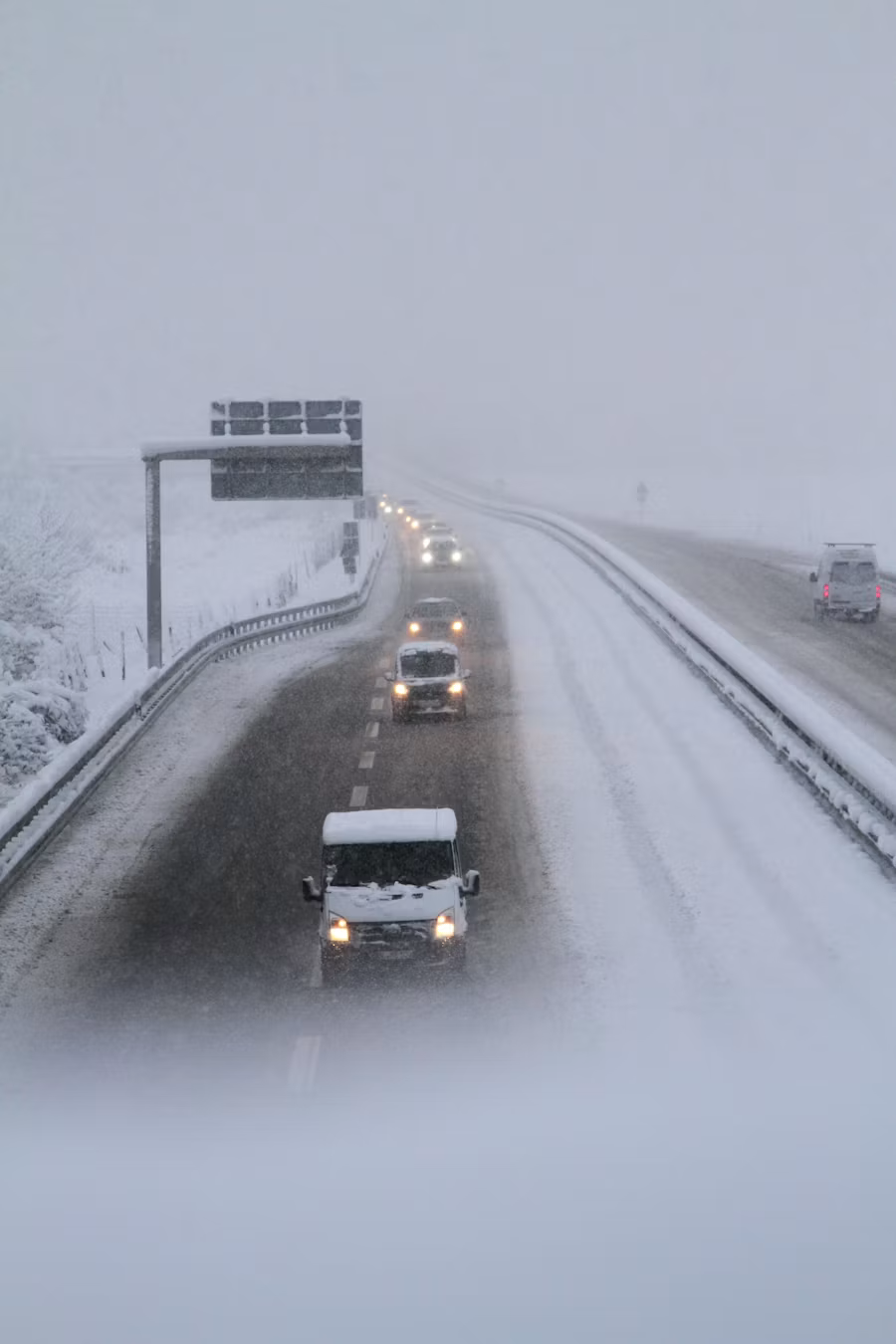
Unless you have winter tires, significant experience driving your specific rig in snow, and a genuine need to be on the road — wait it out. Black ice is invisible and an RV that starts sliding has limited recovery options. No destination is worth it.
If you're full-timing through winter regions, invest in proper tires and practice in light snow before you encounter serious conditions.
Fog
Low beams only — high beams reflect back and reduce visibility further. Slow down significantly. The danger in fog isn't just what you can't see ahead — it's other drivers who can't see you. An RV that's hard to see in fog is a serious hazard to everyone on the road.
Know your rig's specific vulnerabilities
Not all RVs handle bad weather the same way:
If you tow a travel trailer, know your sway control system and have it properly set up before driving in any marginal conditions. A trailer that behaves fine on calm days can become unmanageable in strong crosswinds without proper equipment.
Real-time decisions on the road
Weather changes. What looked manageable at departure can deteriorate quickly. Have a plan before you need it:
The products that help in marginal conditions
Tire pressure monitoring system — tires at correct pressure handle adverse conditions significantly better than underinflated tires. A TPMS gives you real-time readings while moving. Shop on Amazon → [https://amzn.to/49i6fc2]
WeBoost Drive signal booster — staying connected to weather updates and navigation in remote areas requires cell signal. A booster keeps you informed when you're in fringe coverage. Shop on Amazon → [https://amzn.to/4dozL2h]
Portable weather radio — battery-powered NOAA weather radio receives alerts even without cell service. Shop on Amazon → [https://amzn.to/4dByO5w]
The rule that experienced RVers follow
Arrive late or don't arrive — those are always better outcomes than the alternative. Full-timers who have driven hundreds of thousands of miles in RVs will tell you the same thing: the days they stayed put were never the days they regretted.
Build flexibility into your itinerary. If you're locked into arrival times that force you to drive through bad weather, your schedule is the problem, not the weather.
The road will be there tomorrow.
Lorem ipsum dolor sit amet consectetur adipiscing eli mattis sit phasellus mollis sit aliquam sit nullam.